Laminate Tongue and Groove Flooring: The Mechanics of Modern Installation
Laminate flooring owes a significant portion of its popularity to the speed, simplicity, and structural stability of its installation method: the tongue and groove system.
Commonly referred to as “click-lock” or “floating floor,” this ingenious engineering allows planks to snap together without the need for messy glues, nails, or intensive labor.
Understanding the mechanics of modern laminate tongue and groove flooring reveals why it is the preferred installation method for millions of homeowners and provides insights into the floor’s durability and water resistance.
The Anatomy of the Click-Lock System
Every laminate plank is manufactured with a perfectly milled profile on its four edges, forming two key components:
- The Tongue: The raised, narrow profile (or tab) that protrudes from one edge of the plank.
- The Groove: The corresponding recessed channel on the opposite edge of the plank, designed to receive the tongue.
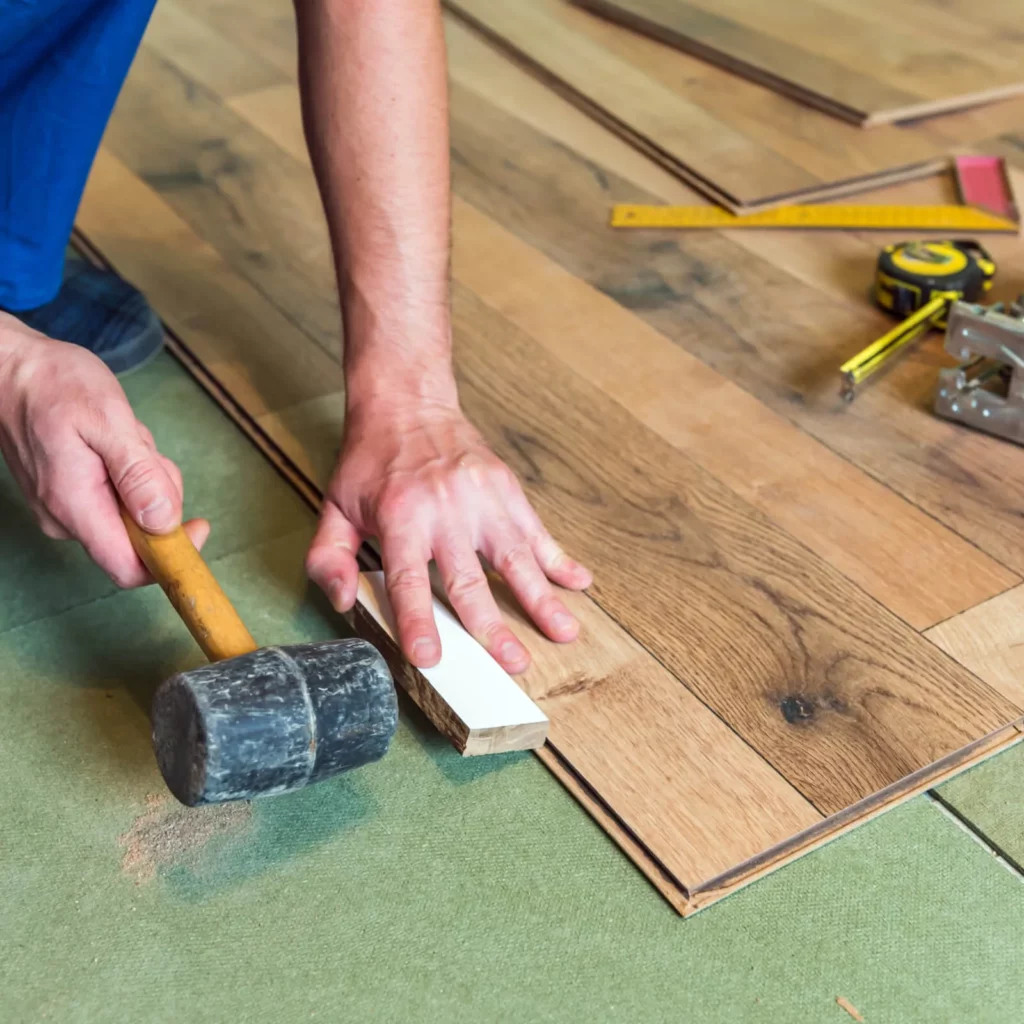
When an installer joins two planks, the tongue of one plank is inserted and gently pressed down or tapped into the groove of the adjacent plank. The precision milling ensures the pieces lock together, creating a connection that is both structurally sound and extremely tight.
Why Floating Floors are the Standard
The click-lock system allows the laminate to be installed as a “floating floor.”
- Definition: A floating floor rests atop the subfloor and underlayment without being permanently fastened by glue or nails. The planks are attached only to each other, forming a single, large, weighted surface.
- Advantage 1: Expansion and Contraction: This system is critical for wood-based HDF core laminate. Because the floor is not fixed to the subfloor, the entire floating surface can expand and contract as a single unit in response to humidity and temperature changes. This prevents buckling and gapping that would occur if the individual planks were rigidly fixed.
- Advantage 2: Ease of Installation: Installation time is drastically reduced. It eliminates the drying time required for glue and the noise and effort of nailing. Most homeowners find click-lock much easier to manage than traditional flooring methods.
- Advantage 3: Simple Repair: If a plank is damaged, it is often possible to disconnect and remove the damaged plank and replace it with a new one—a near-impossible task with glued or nailed flooring.
The Role of Tongue and Groove in Water Resistance
The tongue and groove system is the first line of defense against moisture, especially in modern water-resistant laminates:
- Sealed Barrier: The tighter the connection between the tongue and groove, the more effective the seal against surface spills. In high-quality laminates, the joint is so tight that it prevents topical water from easily penetrating the seam and reaching the vulnerable HDF core.
- Edge Treatment: As discussed with thickness swell, the milling profile of the tongue and groove is often treated with a hydrophobic wax or sealant. When clicked together, this sealant forms a robust, moisture-resistant barrier that reinforces the joint, which is the weakest point in any floating floor.
Considerations for the Installation
While the tongue and groove system simplifies installation, there are still critical steps that must be followed to ensure the system performs correctly:
- The Underlayment: A foam or felt underlayment is essential beneath the floating floor. It provides the crucial moisture barrier, reduces noise transmission (IIC rating), and provides a slight cushion over the subfloor, allowing the tongue and groove system to float properly.
- Expansion Gaps: Since the floor expands and contracts, a required expansion gap (usually ¼ to ½ inch) must be left around the entire perimeter of the room. This gap is hidden by baseboards or quarter-round molding, allowing the massive floating sheet of laminate to move freely without buckling against the wall.
The genius of laminate tongue and groove flooring is its simplicity combined with its structural efficiency. It delivers a fast, stable, and surprisingly water-resistant floor that can be enjoyed for years.

Experience the Ease with Laminate Tongue & Groove Flooring from Dolphin Carpet & Tile
Contact our flooring experts and make sure to visit one of our flooring showrooms in Coral Springs, Davie, Deerfield Beach, Doral, Fort Lauderdale, North Miami, Pembroke Pines, Pinecrest-Palmetto Bay, and West Kendall, FL.